
How an Oklahoma blackmail case slipped away without charges
Andy Dossett | The Wiley Post
Published April 25, 2026
Updated April 28, 2026
This article is labeled as opinion because it includes the writer’s analysis, interpretation or personal viewpoint. Opinion pieces are separate from The Wiley Post’s news reporting.
Update: Before this story was published, the officer in these allegations was removed from his position. This story has been updated to include that development.
I get a lot of calls.
When you're a journalist of one of the last newsrooms still standing in your part of the state, you get a lot of cries for help. People who can't get a call back from the big papers — or even the local ones — start reaching out to anyone who might listen. And I have this really bad habit: I can't say no.
That's how this story found me, and there isn't a day that goes by that I don't think about it.
Early in my career, someone reached out with a story, and they said they had the evidence to back it up. Now, everyone says that, but this person really had it. I tried passing it along to larger, better-resourced newsrooms or one closer to their area, but I didn't get a response.
So I told the source: "Send me everything you got."
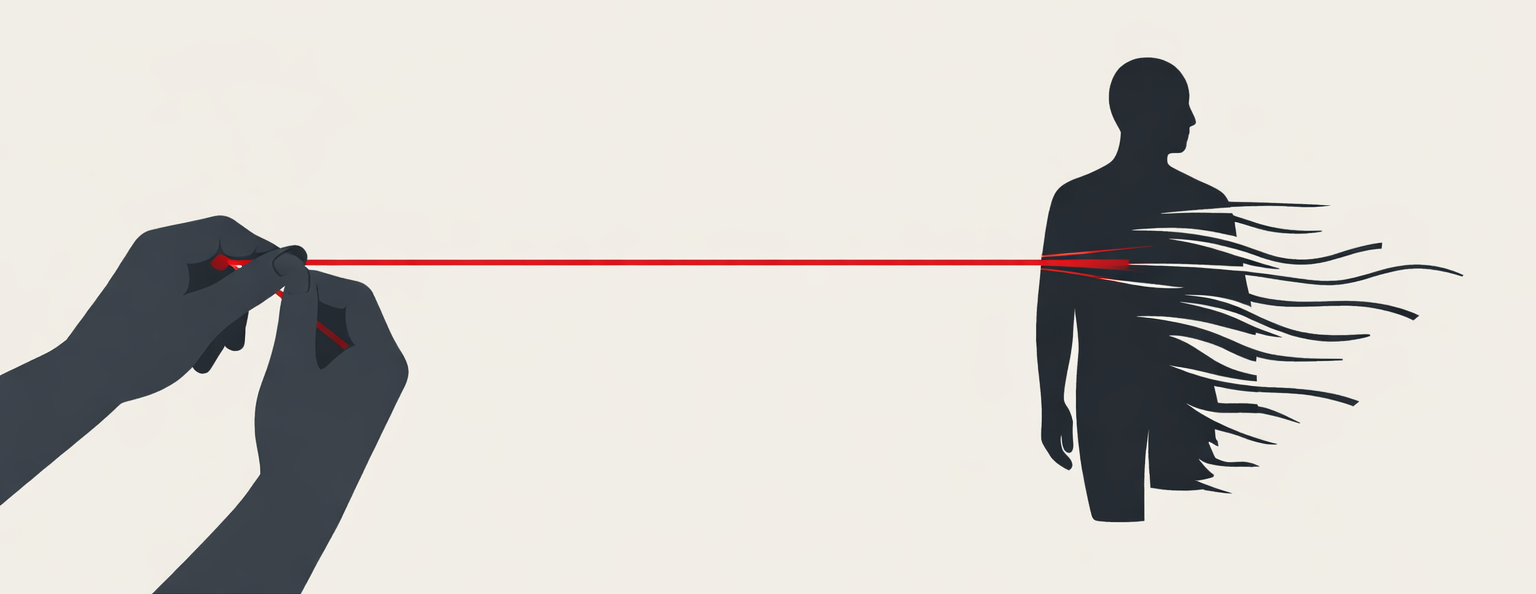
Andy Dossett | The Wiley Post
The source was a police officer, of all things. The veil of "thin blue line" is hardly ever pierced. Usually, officers don't talk to reporters. Some think of us as the enemy, and I don't blame them. When journalists write about the police, unfortunately, it's rarely for a good reason.
He said another officer in his department had lied on his job application. I thought, well, that's not the worst thing. But see, I have this other bad habit. When I see a loose thread, I have to pull it.
A tip leads to a story that would not go away
The account that follows comes from police interviews and from the woman herself — we will call her Jane.
Jane, who was in her 20s, came to the police over 10 years ago with a story: A man — let's call him John — had extorted her out of more than $35,000.
We should say they had had a complicated relationship — one that John took advantage of, exploited and then leveraged into a scheme of manipulation and financial abuse.
These investigation notes contain details of their physical relationship. I'm not going to get into specifics; they aren't important. But what is important is that both Jane and John agree on the scope of their involvement. And these intimate moments were filmed without her knowledge or consent and later used like a noose around her neck.
John claimed that a "friend" had stolen a video from his phone and demanded money to keep it from going online. This video wouldn't harm John, but it would harm Jane.
John acted as the go-between for the blackmailers and Jane. She would wire John money, and he would hand it off to them in person, but John said it wasn't enough. He said they kept asking for more and more money. Jane was scared, alone and ashamed. She felt she had no other choice but to keep handing over cash.
She provided bank statements showing wire transfers to an account in John's name and an account that John would later close.
John's version of the story lines up with Jane's, except his changes a few times throughout his interview with police.
In his interview with police, he slipped up multiple times, contradicting himself. The investigator noted that John pulled up to the station in an expensive new car and, during the interview, took a phone call from a furniture store about scheduling delivery of new furniture.
John said he paid for these things with his savings, or borrowed money from a friend, or maybe borrowed money from Jane. He eventually admitted that perhaps not all the money reached the blackmailers, keeping some for himself — a kind of convenience fee.
At the start, John told a wild tale of meeting with blackmailers in different cities across Oklahoma, tossing a phone containing the video into a river to destroy it, but later revealed the blackmailers had made copies, and that he had also sold one of the phones he got from them to Jane.
When the detective started questioning the story's truth and said it sounded completely made up, John asked if he could just pay Jane back all the money; could this whole thing go away?
At the end of the interview, John asked the detective: What if the blackmailers, the video stolen from his phone and the whole story was just made up? How could he keep this off his record? How much trouble was he in?
Reading between the lines, it appears John's story didn't hold up under police scrutiny, and he was looking for a way out of the mess he got himself into.
After John's questions, the interview ended simply with this line. John then left the police station.
John never faced charges.
In the interview notes, scribbled into the margins over a decade ago, was a phone number. I almost didn’t call, but you know that thread-pulling thing I do.
"Hello, Jane, this is Andy Dossett. I'm an investigative journalist in Oklahoma. I heard about what happened. I want to tell your story. I want you to have justice."
I didn't expect a response. But I got one. That’s how I learned all the parts of the story left out of the investigation notes.
Since it happened so long ago, she was surprised I found out about it. I was shocked she still had the same number. She was also scared to tell her story and relive the shame.
She spoke about how people blame the victim or criticize her for being so naive. But she bravely told me her story nonetheless.
She told me she had gone to the police for help, but never heard anything back. She knew John was pursuing a career in law enforcement and feared maybe someone had helped him make the problem go away. She assumed it was over.
She didn’t offer the story easily. I convinced her to share because I said I wouldn't give up. I wanted to make sure there weren't any other victims and that John would be held accountable.
I reached out to the district attorney's office over the case. I called. I emailed. I never got a response.
Eventually, through a back channel, I got an answer. During the investigation, the DA's office changed leadership due to an election. The source said they gathered the case just fell through the cracks — no cover-up, just old-fashioned bureaucracy.
By the time I dug it back up, the statute of limitations had run out. There would be no charges.
A promise made and broken
I want to be clear, Jane didn't seek me out. She had already moved on. She was married with children. She found a way to make an uneasy peace with what happened.
It was me doing the digging.
When I told Jane that there couldn’t be charges — that nothing would happen to John — she said not to bother with it.
This is where we learn about one of my other bad habits. I can make promises I don't know I can't keep.
She trusted me to find her justice, and I failed her.
For the weeks we talked back and forth, that forgotten past was pulled back into her life — and each time we spoke, I could hear her starting to believe me, believe she could have real closure.
But in the end, all I did was revictimize a woman who had already been let down by everyone else.
She had to relive it again. Worse, she had to learn the full extent of John's manipulation: the lies he told, the money he stole and the ways he frittered it away.
And how the police knew, but still he walked away.
Moving a couple of years down the road, let's read a line from John's police application:
List all the times you've had contact with any law enforcement agency, including all incidents where you have been questioned, warned, issued a summons, detained, arrested or convicted.
He left it blank.
Everything from Jane and the police investigation is, after all, pretty damning. However, it's still, as we journalists say, "alleged." It's not proven. John is an innocent man, and after all, the police investigated him and never filed charges.
All we have is the destruction that was left behind.
But his omission on his application is a lie. A disqualifying one. But it didn't disqualify him. He won't see any repercussions for it. Par for the course.
Where is John? Well, he married the woman he was dating at the time he was allegedly filming and extorting Jane out of almost $40,000.
He has children now. He got to fulfill his dream of wearing a badge in Oklahoma.
Jane said that before being blackmailed, she had once caught John filming her. While deleting the video from his phone, she also deleted photos and videos of other women she didn't recognize.
With how this story ends, all I can think is I hope John's daughter never meets someone like her father. Or please tell me at least he taught her how to avoid men like himself.
There's no justice for this story. There will be no public reckoning for John. He never paid her back. He allegedly got away with it.
All we have is a woman whom I forced to relive her trauma. A promise I made that I couldn't fulfill. And an alleged predator now in uniform, whose actions never caught up to him.
This isn't a gotcha piece. It's about what happens when institutions fail, the dangers of putting trust in something or someone.
We can't go back. But maybe we can stop it from happening again.
And maybe, just maybe, next time, someone will listen the first time a victim speaks up.
A silver lining
My goal in reporting this story was never to spread rumors or start a witch hunt. I intentionally removed as much personally identifying information as possible to protect those involved. Still, there is enough here that those familiar with the case may connect the dots.
Between the time I began investigating these allegations and the publication of this column, “John” served as a police officer. When the allegations came to light, he was removed from that position. While the statute of limitations has expired on the alleged crimes, at least some action was taken.
I have also learned that at one point, a warrant was prepared for John’s arrest, but it was allegedly misfiled and never presented to a judge.