
Andy Dossett | The Wiley Post
Nov 5, 2026
Three newcomers take office Dec. 7 after an election shaped by disputes over public comment, surveillance cameras, firefighter negotiations and the influence of county politics.
Bartlesville voters ousted two incumbent City Council members Tuesday, Nov. 3, including Vice Mayor Trevor Dorsey, reshaping the five-member council after two years of political disputes over how the city is governed.
But while the election changed a majority of the council's membership, it remains unclear how much the city's direction will change.

Former Bartlesville Mayor Dale Copeland congratulates Michael Colaw on his Ward 1 City Council victory Tuesday, Nov. 3. Copeland lost the same seat to Tim Sherrick in 2024, while Colaw defeated Sherrick in this year's election.
Andy Dossett | The Wiley Post
Michael Colaw defeated Ward 1 incumbent Tim Sherrick, David Austin won the open Ward 2 seat and Eddie Collins unseated longtime Ward 5 representative and Vice Mayor Dorsey. Mayor Jim Curd retained his Ward 3 seat, while Councilman Aaron Kirkpatrick won reelection in Ward 4.
The results leave two returning incumbents and two newcomers who expressed confidence in the city's direction, alongside Collins, who campaigned on reversing several existing policies.
They also create a potential continuation of a familiar political divide.
Sherrick frequently found himself opposing the council majority during his two-year term, sometimes casting the lone dissenting vote. Collins, who shares several of Sherrick's policy positions and has also held a leadership role in the Washington County Republican Party, now takes a seat on the council.
Whether Collins assumes a similar role remains to be seen.
For Bartlesville residents, the election leaves unanswered questions about public participation at council meetings, police surveillance technology, the city's relationship with its firefighters union and the direction of local economic development.
With all 27 precincts reporting, unofficial results showed 10,887 votes cast across the five council races.
Continuity and change define election results
The election presented voters with competing views of Bartlesville's progress and the role of city government.
Colaw and Austin emphasized continuing the city's current direction rather than entering office with specific political agendas.
Both praised the Bartlesville Development Authority and expressed confidence in the city's economic development decisions. They also supported the selection of Terry Lauritsen as the next city manager, describing the city's overall direction favorably.
Curd and Kirkpatrick, meanwhile, campaigned on their records and the city's continued progress, including economic development and infrastructure investment.
Other candidates focused more heavily on changing existing policies.
SUPPORT LOCAL JOURNALISM
Support The Wiley Post's mission
Help sustain independent journalism that keeps our community informed and holds leaders accountable.
Become a subscriberSherrick, Cameron Byers, Josh Lock, Amanda Veley, Joel Rabin and Collins all made restoring broader public-comment opportunities a campaign issue. Several also challenged the city's use of automated license plate readers, commonly known as Flock cameras.
Some questioned whether the outgoing council should have selected a new city manager immediately before the election rather than allowing the next council to make that decision.
Of the six candidates who campaigned on reversing public-comment restrictions, only Collins won.
That does not establish why individual voters supported particular candidates. Local elections involve multiple issues, and voters may have weighed qualifications, leadership styles and neighborhood concerns differently.
But it does determine which campaign priorities will have representation on the incoming council.
Colaw and Austin did not make reversing public-comment rules a campaign priority, nor did they commit to removing Flock cameras. Whether either will support changes to those policies remains unclear.
County GOP influence becomes part of council debate
The Washington County Republican Party's involvement in municipal affairs has become an increasingly visible feature of Bartlesville politics, despite City Council elections being officially nonpartisan.
Three candidates in Tuesday's election held leadership positions within the county party.
Ward 1 incumbent Sherrick, who lost his reelection bid to Colaw, was a WCGOP precinct chairman and member of the party's executive committee.
Ward 3 challenger Josh Lock, who lost to Curd, serves as the WCGOP's treasurer, a district committeeman and a precinct chairman.
Collins, who defeated Dorsey in Ward 5, was elected a Republican state committeeman in 2025 and also serves as a WCGOP precinct chairman.
All three campaigned on restoring broader public-comment opportunities at council meetings and removing automated license plate-reading cameras.
During his two years on the council, Sherrick frequently challenged decisions supported by the majority, sometimes casting the lone dissenting vote. Outgoing Ward 2 Councilman Larry East joined him on several occasions, including votes opposing the city's continued use of license plate readers.
The county party itself took formal action against two members of the council.
In October 2025, the WCGOP County Committee voted to censure Curd and Dorsey for supporting continued use of license plate readers rather than allowing voters to decide whether the technology should remain.
The party cited Fourth Amendment privacy concerns and accused both officials of disregarding an earlier party resolution opposing the technology.
Now a year and a half later, Curd won reelection while Dorsey lost his seat to Collins, one of the candidates who campaigned against the cameras.
Curd expressed frustration with this year's campaign, saying he believed the election had become more focused on party politics than on the policies and practical decisions facing Bartlesville.
He argued that the city's nonpartisan council should focus on serving residents and addressing local needs rather than advancing political agendas.
The differing election outcomes do not establish how voters viewed the party's involvement. But they leave Collins entering a council where several of the policy disagreements championed by WCGOP leaders remain unresolved.
Whether Collins takes up the political battles Sherrick waged during his two years on the council remains to be seen. Both held leadership positions within the WCGOP, placed their Christian faith at the forefront of their campaigns and advocated changes to several of the same city policies.
Those similarities suggest some of the political divisions that defined Sherrick's tenure could continue under Collins, though how he approaches those issues from his seat on the council remains an open question.
Public-comment restrictions remain unresolved
One of the most persistent disputes during the past two years has involved who gets to address the City Council and what subjects may be discussed during public-comment periods.
The controversy intensified after WCGOP leaders and activists, including some who lived outside Bartlesville, began attending council meetings to advocate positions on local issues.
Curd has said the council revised its public-comment rules in response to people outside city limits using meetings to push political agendas.
The current rules generally restrict public comments to posted agenda items and limit participation to people who meet specified connections to Bartlesville, including residency, property ownership, city business licensing or authorized representation.
Supporters of the restrictions argued that council meetings should remain focused on city business and the interests of the residents the council represents.
Opponents argue that the changes limit public participation and make it harder for people to bring concerns directly to elected officials.
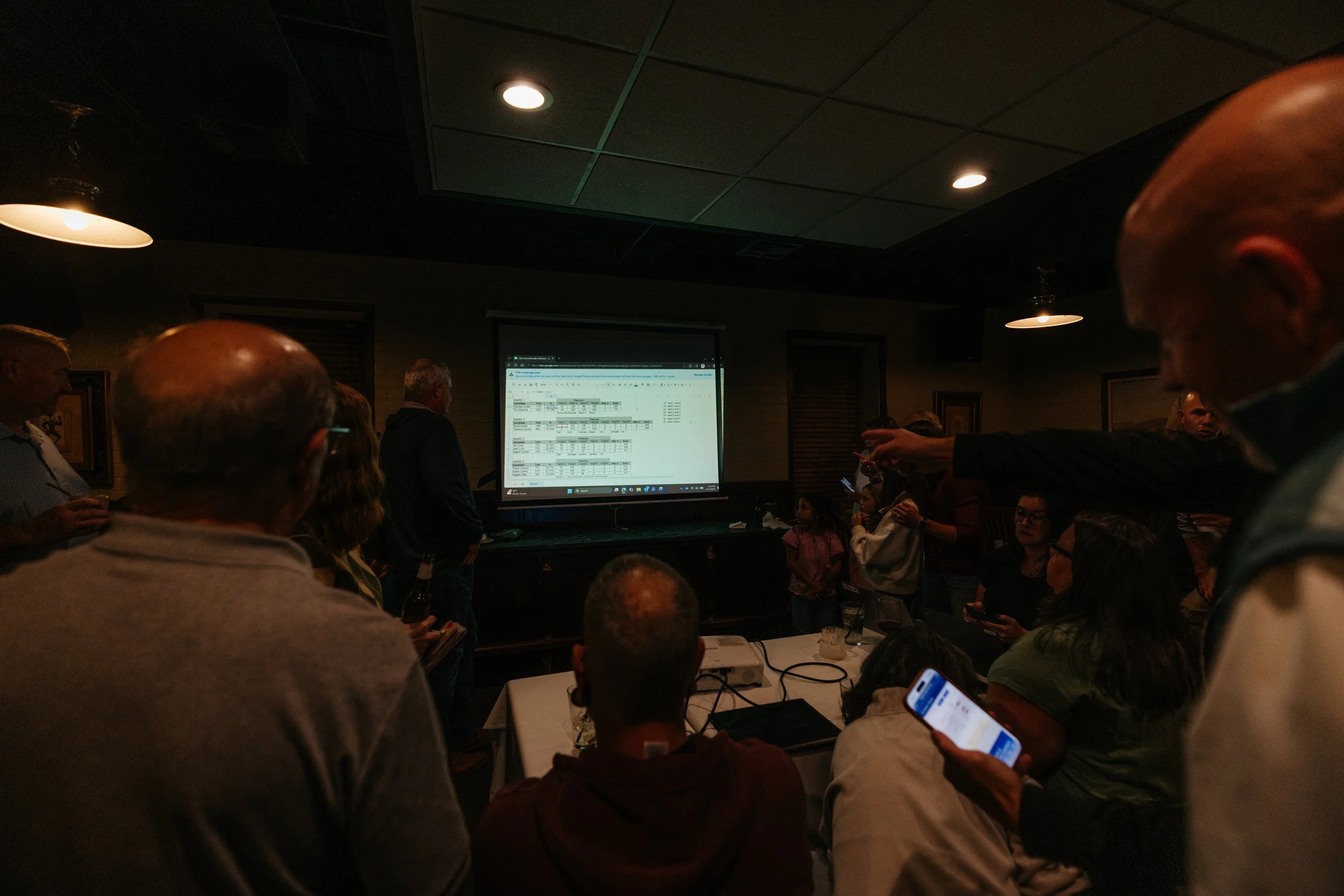
Election night attendees gather around a projected display of unofficial results Tuesday, Nov. 3, as voters select all five members of the Bartlesville City Council.
Andy Dossett | The Wiley Post
The dispute became a central campaign issue for several challengers, who promised to restore broader opportunities for public comment if elected.
Those promises were particularly prominent among candidates associated with the broader movement to change council policies.
The political divisions also have roots in the 2024 election, when Sherrick and East campaigned on efforts to prohibit public drag performances.
Neither succeeded in securing a ban during the following two years.
In the days leading up to this year's election, Collins renewed criticism of Dorsey over the lack of a ban, even though the last public drag performance identified during the campaign occurred in 2024.
With Collins the only victorious candidate among those who campaigned specifically to restore previous public-comment rules, the issue's future depends on whether other council members will reconsider the policy.
Flock cameras remain a test for incoming council
The city's use of automated license plate readers became one of the clearest divisions between candidates.
The cameras capture license plate information that police can search during investigations, including cases involving stolen vehicles, missing people and other crimes.
Supporters say the technology gives law enforcement another investigative tool. Opponents raise concerns about government surveillance, constitutional protections and the potential misuse of collected information.
The council adopted restrictions governing the program in 2025, including limits on information sharing and additional oversight requirements.
In August 2026, the council voted 3-2 to continue using the technology while adjusting the program and introducing cameras from another vendor.
Sherrick and East opposed the decision, while Curd, Kirkpatrick and Dorsey supported it.
During the election, Sherrick, Byers, Lock and Collins advocated removing the cameras.
Colaw and Austin offered more measured responses of support, emphasizing the need to evaluate the technology and the city's existing policies rather than commit to removing it.
Curd, Kirkpatrick and Dorsey continued supporting the program under the safeguards adopted by the council. Dorsey, Curd, Kirkpatrick, Colaw and Austin all received endorsements from the local police union.
With Sherrick and East departing, two established opponents of the technology will no longer be at the council table. Collins, however, arrives having campaigned against its use.
The existing regulations remain in place unless the incoming council takes action to change them.
Firefighters union faces uncertain future in negotiations
The next council also inherits a strained relationship between the city and Bartlesville Professional Firefighters Local 200.
The union and city have spent much of the past years in disagreements over contract provisions, including promotions, staffing, overtime and sick leave.
Those disputes led to arbitration, with the council approving the union's last best offer for the remainder of the 2025-26 fiscal year in March.
The city and union offered different interpretations of the arbitrator's findings. Union representatives emphasized their contract proposal, while city officials pointed to findings supporting concerns about promotion practices and sick leave.
Negotiations for a subsequent agreement became another source of tension.
After former City Manager Mike Bailey's departure in August, negotiations stopped.
Union representatives have also argued that restrictions at City Council meetings limited their ability to present concerns directly to elected officials, leaving collective bargaining and arbitration as their primary avenues for addressing disagreements.
The union entered the election by endorsing Sherrick, Byers, Lock and Collins, with hopes that the incoming council would take a different approach to negotiations.
Only Collins won.
His election places one union-endorsed candidate on the new council, but it does not settle the outstanding disagreements or establish how the council will approach future negotiations.
Those decisions will involve the incoming council, newly hired City Manager Terry Lauritsen and representatives of the firefighters union.
City manager appointment reflects another divide
The hiring of Lauritsen also became a campaign issue, highlighting disagreement over whether the outgoing council should make a major leadership decision so close to an election.
Bailey's August departure left the city searching for a new administrator as all five council seats neared the November ballot.
Curd and a majority of the council supported moving forward with an internal hiring process and ultimately selected Lauritsen, the city's longtime Water Utilities director.
Sherrick questioned the process, including the decision not to conduct a broader external search and the timing of the appointment.
Several council challengers similarly argued that the newly elected council, not officials whose terms were about to end, should make the selection.
Their objections centered on the selection process and timing, with some arguing that a broader search was necessary to ensure the city hired the most qualified candidate. None publicly challenged Lauritsen's qualifications or stated that he should not hold the position.
Colaw and Austin, by contrast, expressed confidence in Lauritsen and supported the city's decision.
The outgoing council approved Lauritsen's employment contract Nov. 2, one day before voters went to the polls, with Sherrick casting the lone no vote.
He was sworn in that evening.
The appointment gives the incoming council an administrator with more than two decades of city government experience, including responsibility for water utilities and major infrastructure programs.
It also means one of the decisions several challengers wanted to leave to the next council had already been made.
Dorsey reflects on lessons learned in office
The election's most significant leadership departure comes in Ward 5, where Collins defeated Dorsey after the vice mayor served four full terms and part of another.
Dorsey received 823 votes, or 33.92%, compared with Collins' 1,232 votes, or 50.78%. Angela Utley finished third with 371 votes.
Following the election, Dorsey expressed pride in the city's progress and gratitude for his years of public service.
"I enjoyed my time of service,” Dorsey said. “I wouldn't trade it for anything in the world."
But he also offered a candid reflection on how his approach to the job changed over time.
"I think the first 4 years I served I failed to represent everyone," Dorsey said, acknowledging that he had initially placed too much emphasis on advancing a political agenda.
He said experience taught him that serving on the council requires representing residents regardless of whether they share the same beliefs.
"You don't have to agree with everyone, but you have to respect everyone," he said.
His comments come as Collins prepares to join a council with members who have taken different positions on several issues central to his campaign.
In a Facebook statement thanking Ward 5 voters, Collins emphasized his desire to keep hearing from residents.
"Regardless of your opinions, I want to hear your concerns and ideas!" Collins wrote.
The two statements reflect a shared acknowledgment of the importance of listening to constituents, even as their political positions and approaches to city government have differed.
New council faces leadership decision Dec. 7
Bartlesville's five council members will take office Monday, Dec. 7, when they will select a mayor and vice mayor for the next two years.
Although Curd retained his Ward 3 seat with 49.78% of the vote in a three-way race, his continuation as mayor is not guaranteed. That decision rests with the incoming council, which also must choose a successor to Dorsey as vice mayor.
The new council will also inherit economic development initiatives, infrastructure projects, firefighter contract negotiations and questions about policies that divided candidates throughout the election.
For Colaw and Austin, the coming term offers an opportunity to build on the city's direction they supported during their campaigns. For Collins, it provides an opportunity to pursue changes he argued were necessary.
Curd and Kirkpatrick return with established positions on many of those issues, but the arrival of three new members introduces new voices into council discussions.
The election also leaves questions about whether the partisan divisions that surfaced during the past two years will continue to influence a governing body whose elections are officially nonpartisan.
Sherrick's departure removes a frequent dissenting voice from the council, but Collins' arrival means several of the same policy disagreements will still be represented.
Whether the new council revisits past controversies, finds compromises or largely continues the city's existing direction will depend on decisions made after its members take office.
For Bartlesville voters, Tuesday's election decided who would represent their wards.
What those representatives do together will determine how much actually changes at City Hall.
A LITTLE NOTE FROM THE WILEY POST
You made it to the end.
Thank you for reading.
We believe local news should be available to everyone, not hidden behind a paywall. Readers who support The Wiley Post help us keep it that way.
Join the readers who make it possibleIndependent journalism for Oklahoma, born in Bartlesville.