How Oklahoma lost its chance to lead in reading
Sandy Dossett | Special to The Wiley Post
August 3rd, 2026
This article is labeled as opinion because it includes the writer’s analysis, interpretation or personal viewpoint. Opinion pieces are separate from The Wiley Post’s news reporting.
In the fall of 2012, I sat across the table from a frustrated rural Oklahoma principal who looked at me and said,
"Some of these kids' parents never learned to read, and they're never going to learn to read."
Fourteen years later, Oklahoma ranks at the bottom nationally in fourth-grade reading. I often think back to that conversation.
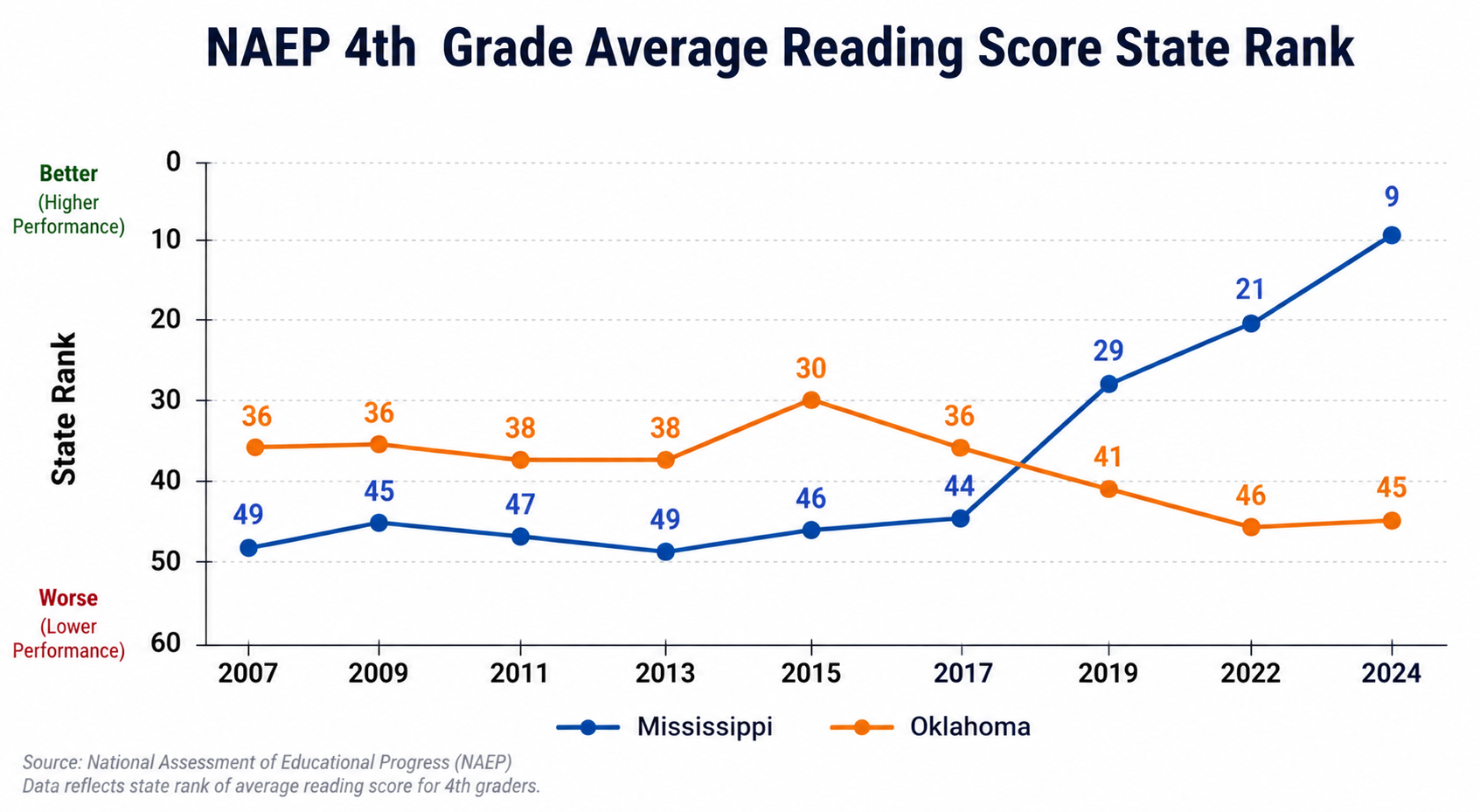
The National Assessment of Educational Progress, often called the nation's report card, measures reading and math achievement every two years. Over the past decade, its data show Oklahoma sliding to the bottom while Mississippi climbed to the top.
Not many people realize we could have been where Mississippi is today.
No single policy transformed Mississippi or doomed Oklahoma. But one state stayed committed to a comprehensive literacy strategy while the other weakened it before it had time to mature.
In 2011, Mississippi ranked 47th in fourth-grade reading. Today, it ranks 9th.
Oklahoma ranked 38th in 2011. After lawmakers adopted a third-grade retention amendment to the Oklahoma Reading Sufficiency Act, Oklahoma climbed to 30th by 2015.
That Oklahoma amendment required students who could not demonstrate basic reading proficiency (second-grade-level reading skills) by the end of third grade to receive intensive intervention and, in some cases, repeat third grade.
By the 2015-16 school year, the law was changed, and regardless of whether students could demonstrate the appropriate level of reading skills, they could be promoted by a committee composed of a parent, third-grade teacher, certified reading specialist, fourth-grade teacher and principal.
Like Marlon Brando's character in "On the Waterfront," I sometimes want to shout, "We could have been a contender."
After lawmakers weakened the law, Oklahoma's reading performance steadily declined. Retention alone wasn't responsible for those gains between 2011 and 2015, but abandoning the broader literacy strategy — including accountability, coaching and teacher training — proved far more damaging.
By 2024, Oklahoma fell to 45th in fourth-grade reading scores.
What I saw inside Oklahoma classrooms
Third-grade retention was never intended to punish children. It was designed to create urgency for the adults responsible for teaching them to read. For a time, it did exactly that.
In the 2012-2013 school year, I was one of 60 educators hired as REAC3H literacy coaches. We were trained and sent out to help schools adjust to the new reading law amendments and to explain how the third-grade retention law worked because six exceptions could be used to promote students.
The law included multiple exemptions for English learners, some students with disabilities, portfolios demonstrating proficiency and opportunities to retest after intervention. Contrary to popular belief, the law was never designed to retain struggling readers automatically.
Support The Wiley Post's mission. Become a subscriber today and help sustain independent journalism that keeps our community informed, holds leaders accountable, and tells the stories that matter.
That original conversation with a frustrated rural principal came during one of my first meetings.
I shared with him what decades of literacy research have shown: roughly 95% of first-grade children can learn to read when they receive direct, explicit and systematic instruction. Students who reach reading fluency in first grade are far more likely to remain on grade level throughout elementary school.
Over the next two years, I worked with that principal, his third-grade team of teachers, their special education team, and their anxious and worried parents as we put a plan together to do all we could to help those students gain the reading skills they needed to show proficiency.
Half of the school's third graders entered the year unable to read.
At the end of the year, approximately 80% passed the state reading test. The vast majority of the students who didn't pass fit one of the exemptions, and a few went to summer school to retake the test. That community of educators, students, and parents made it happen.
Teacher training helped drive early gains
By 2015, Oklahoma moved up significantly in reading scores. To achieve the success that the school and state experienced, Oklahoma invested in intensive teacher training. It hired dozens of literacy coaches to help support schools as they tried to follow the requirements of the new changes to state law.
I was skeptical when state leaders promised we'd become some of the best-trained literacy educators in Oklahoma. But true to their word, they brought in nationally recognized experts to train us in Language Essentials for Teachers of Reading and Spelling (LETRS), then widely regarded as the gold standard in literacy training for teachers.
We then carried that training into classrooms across the state.
Mississippi made a similar investment but took it a step further. The state mandated that all its early elementary teachers receive LETRS training, while Oklahoma's training was voluntary. Mississippi later required the same training for the university faculty preparing future kindergarten through second grade teachers. The result was a statewide evidence-based approach to reading instruction and a common language around literacy instruction.
Mississippi also continued that training with coaches across the state supporting struggling schools with resources, classroom coaching and targeted follow-up professional development.
Oklahoma stopped investing
Unlike Mississippi, Oklahoma's coaching and training program ended after just two years when the federal grant expired, and lawmakers declined to continue funding it.
To this day, I don't know why the state chose not to continue those positions or the initiative.
On the day we received word that our contracts wouldn't be renewed, a colleague and I were presenting LETRS training to teachers in our area of the state. In those two years, Oklahoma barely scratched the surface but saw significant gains nonetheless.
When those 60 coaches disappeared, so did Oklahoma's statewide system for consistently training and supporting teachers in evidence-based reading instruction.
Mississippi continued refining its literacy strategy.
Rachel Canter, founder of Mississippi First, identifies four pillars behind the state's success: standards and accountability, consequences for poor performance, evidence-based instruction and sustained implementation support.
Those policies became the foundation of what many now call the "Mississippi Miracle" and Canter calls the Mississippi Marathon.
Where Oklahoma goes from here
None of this diminishes the hard work educators have been doing and are doing today. I have met countless teachers who are deeply committed to helping children read. Many, many educators pour their heart and soul into what they are doing. We have pockets of success all across our state.
But I've lost count of how many teachers attending training sessions have told me, "Why didn't I ever learn this about teaching reading?" My answer has been the LETRS mantra, "When we know better, we do better."
After spending 15 years teaching English in the classroom, I spent the next 14 years working in literacy as a coach, consultant, curriculum development specialist and LETRS National Facilitator, helping thousands of teachers in 27 states, including Mississippi.
With those three decades of experience, I've seen schools transform when educators had the right tools and support, and I've watched promising reforms fade before they had a chance to take root.
Over the next few weeks, I'd like to share my insight on our newest reading law, the Strong Readers Act and the initiatives to support it: the pros, the cons, the pitfalls we want to avoid and how our promising initiatives compare to what Mississippi did successfully.
Because our kids deserve better than a decade of excuses.
We know better.
It's time to do better.